










































 现代生活打乱了睡眠和饮食的时间规律,研究表明长期如此对健康有不良影响。有证据表明,长期打乱体内昼夜规律可能与癌症相关,例如长期夜班可能增加乳腺癌和前列腺癌的风险。不过,伴随现代生活而来的睡眠和饮食模式不合时宜,对于癌症的具体影响尚不明确。
2018年7月17日,国际抗癌联盟《国际癌症杂志》在线发表西班牙全球卫生研究所、马尔医学研究所、庞佩乌法布拉大学、生物医学研究联盟、卡洛斯三世卫生研究所、阿尔卡拉大学、坎塔布里亚大学、纳瓦拉公共卫生研究所、莱昂大学、圣塞巴斯蒂安卫生研究所、韦尔瓦大学、巴伦西亚社区健康和生物医学研究促进基金会、加泰罗尼亚肿瘤研究所、略夫雷加特医院、巴塞罗那大学的研究报告,根据生活方式和早晚活动偏好相关特征,调查了进食时间是否影响乳腺癌和前列腺癌的风险。
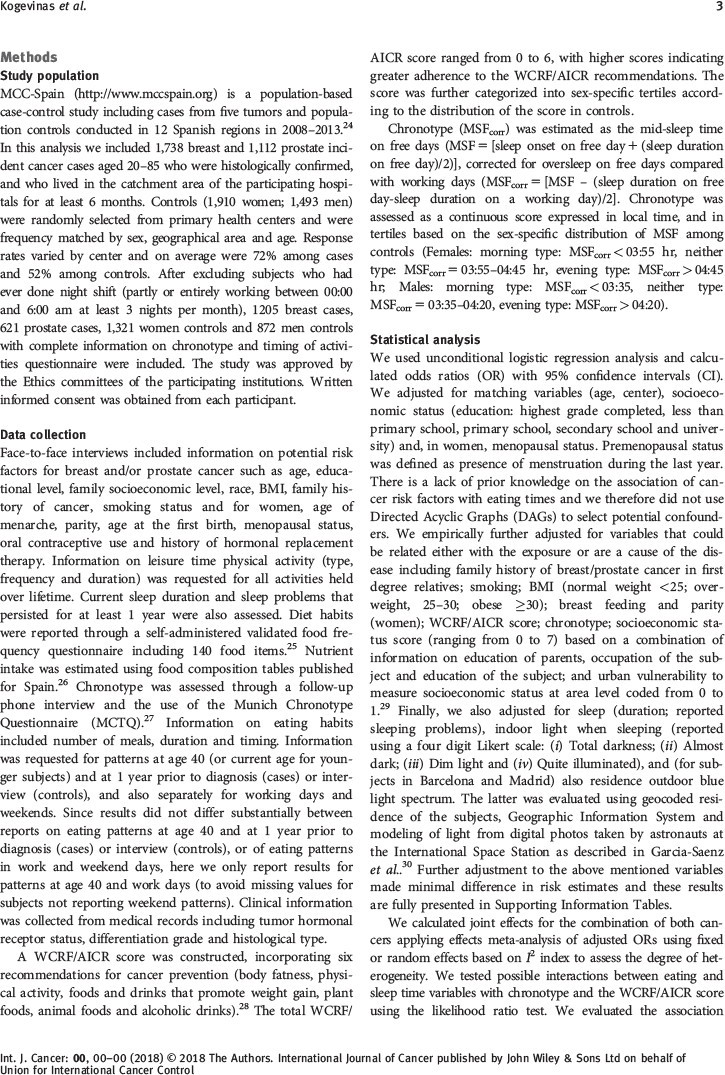
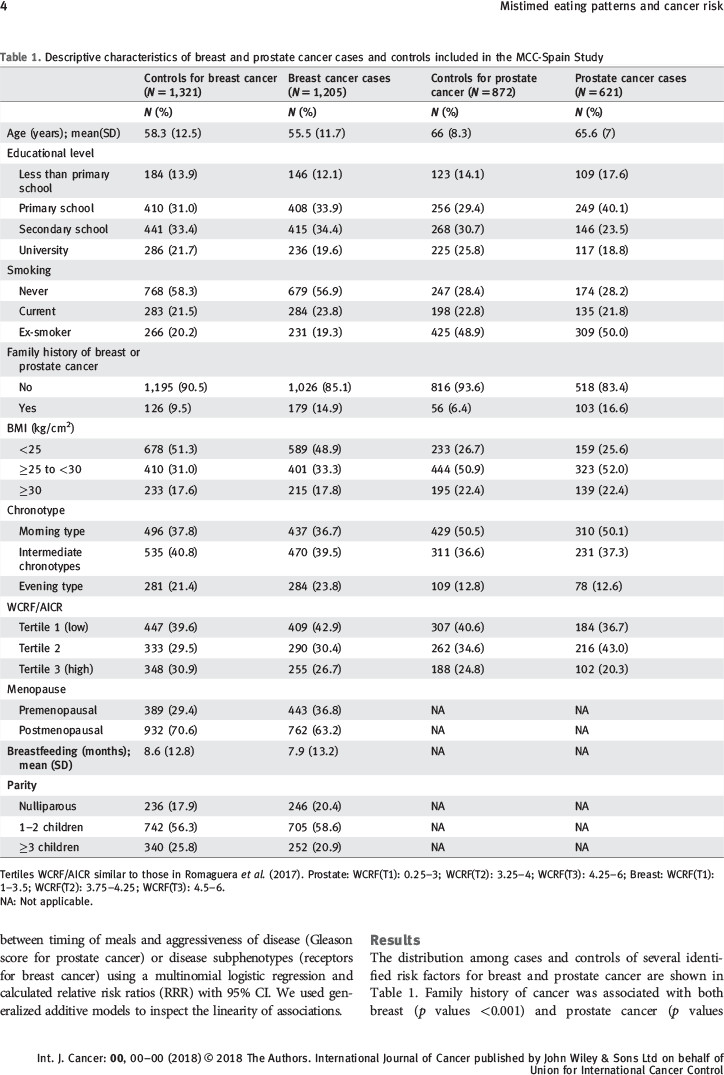
该人群病例对照研究于2008~2013年在西班牙全国12个地区开展,分析了621例前列腺癌、1205例乳腺癌病例,以及从不晚上工作的872例男性、1321例女性对照人群。对调查对象进行关于进餐、睡眠、活动时间偏好的访谈,并且完成食物频次问卷,分析是否符合世界癌症研究基金和美国癌症研究所的癌症预防推荐意见。根据年龄、学历、女性绝经、地区等影响因素对结果进行校正。
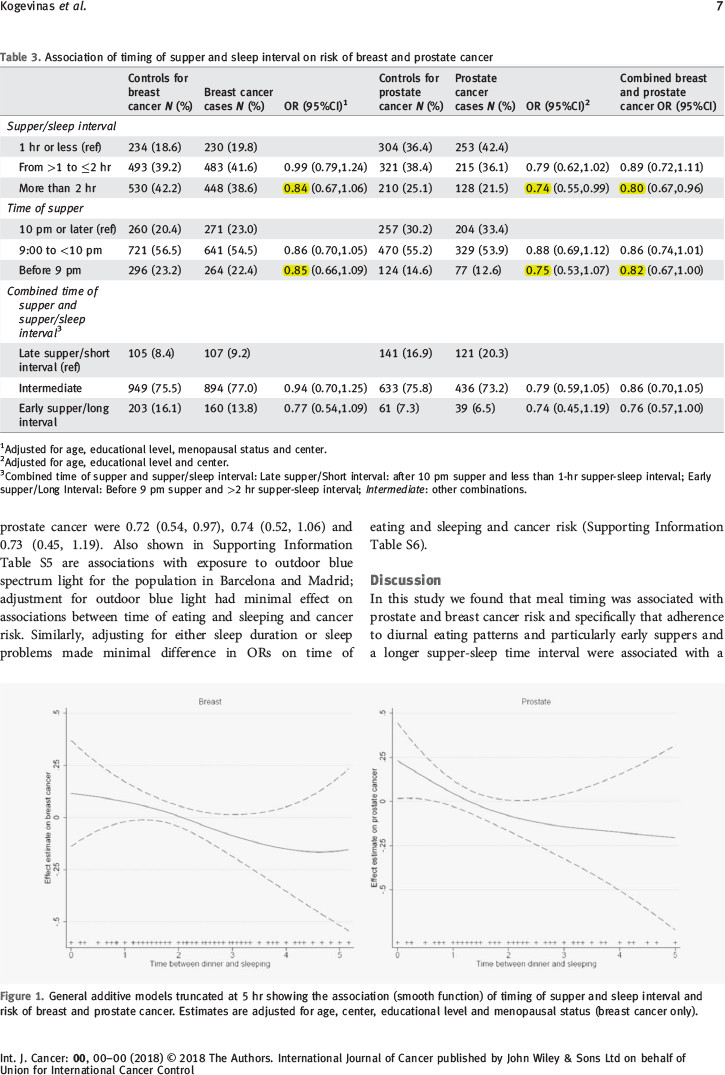
结果发现,晚餐时间9点之前与10点之后相比:
两种癌风险减少18%(比值比:0.82,95%:0.67~1.00)
乳腺癌风险减少15%(比值比:0.85,95%:0.66~1.09)
前列腺风险减少25%(比值比:0.75,95%:0.53~1.07)
晚餐至睡觉时间间隔≥2小时与≤1小时相比:
两种癌风险减少20%(比值比:0.80,95%:0.67~0.96)
乳腺癌风险减少16%(比值比:0.84,95%:0.67~1.06)
前列腺风险减少26%(比值比:0.74,95%:0.55~0.99)
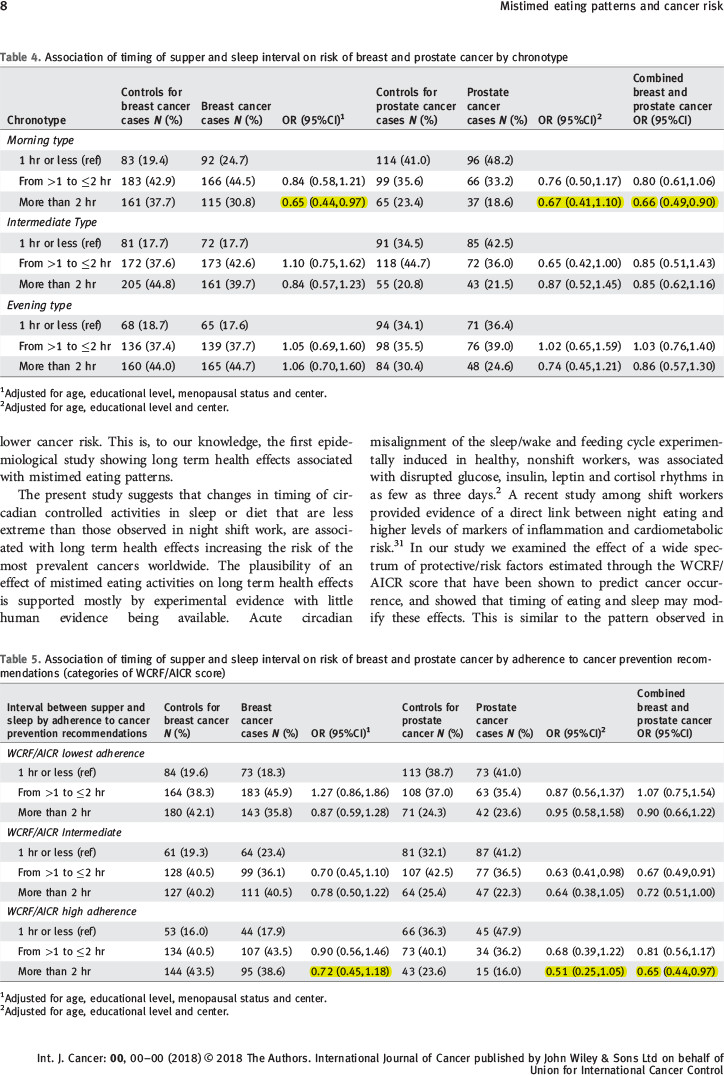
如果饮食符合癌症预防推荐意见,晚餐至睡觉时间间隔≥2小时与≤1小时相比:
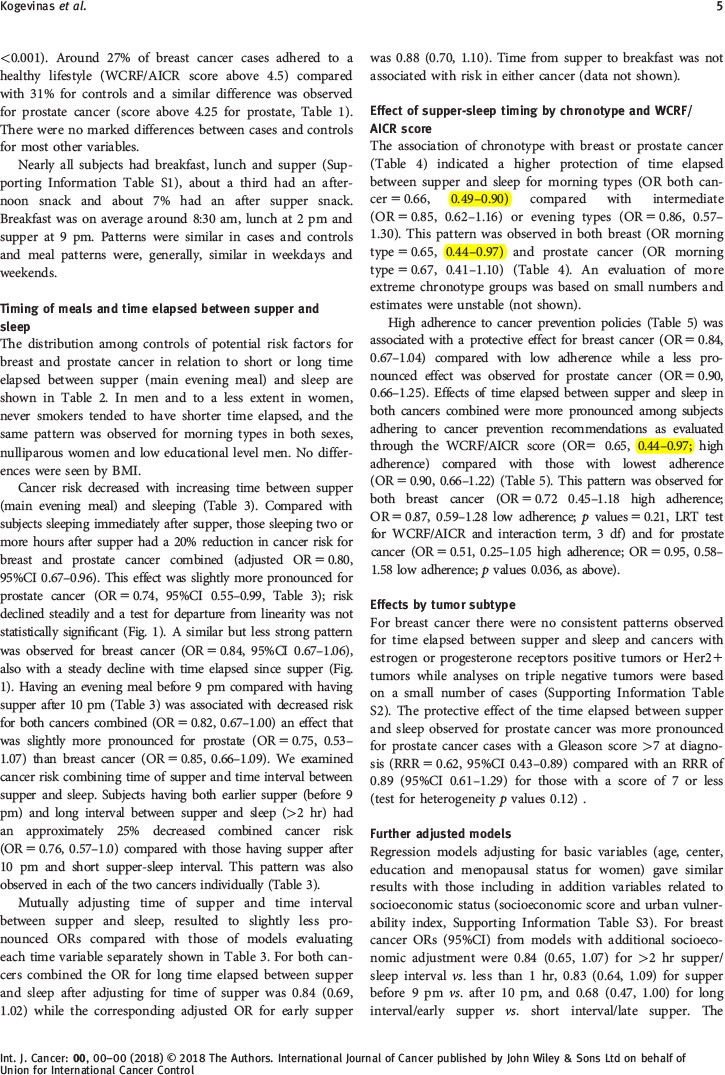
两种癌风险减少35%(比值比:0.65,95%:0.44~0.97)
乳腺癌风险减少28%(比值比:0.72,95%:0.45~1.18)
前列腺风险减少49%(比值比:0.51,95%:0.25~1.05)
如果早晚活动偏好为早睡早起型,晚餐至睡觉时间间隔≥2小时与≤1小时相比:
两种癌风险减少34%(校正后比值比:0.66,95%置信区间:0.49~0.90)
乳腺癌风险减少35%(校正后比值比:0.65,95%置信区间:0.44~0.97)
前列腺风险减少33%(校正后比值比:0.67,95%置信区间:0.41~1.10)
因此,该研究结果强调了时间规律对于饮食与癌症的重要性,早睡早起、饮食符合癌症预防推荐意见、尤其晚餐时间较早并且与睡觉时间间隔较长,可能减少乳腺癌和前列腺癌的风险。
Int J Cancer. 2018 Jul 17. [Epub ahead of print]
Effect of mistimed eating patterns on breast and prostate cancer risk (MCC-Spain Study).
Manolis Kogevinas Ana Espinosa Adela Castelló Inés Gómez-Acebo Marcela Guevara Vicente Martin Pilar Amiano Juan Alguacil Rosana Peiro Victor Moreno Laura Costas Guillermo Fernández-Tardón Jose Juan Jimenez Rafael Marcos-Gragera Beatriz Perez-Gomez Javier Llorca Conchi Moreno-Iribas Tania Fernández-Villa Madalen Oribe Nuria Aragones Kyriaki Papantoniou Marina Pollán Gemma Castano-Vinyals Dora Romaguera.
ISGlobal, Barcelona, Spain, IMIM (Hospital del Mar Medical Research Institute), Barcelona, Spain, Universitat Pompeu Fabra (UPF), Barcelona, Spain, CIBER Epidemiología y Salud Pública (CIBERESP), Madrid, Spain, Instituto de Salud Carlos III, Madrid, Spain, University of Alcalá, Madrid, Spain, Universidad de Cantabria - IDIVAL, Santander, Spain, Public Health Institute of Navarra, IdiSNA, Pamplona, Spain, Universidad de León, León, Spain, BioDonostia Research Institute, San Sebastian, Spain, Universidad de Huelva, Huelva, Spain, Fundación para el Fomento de la Investigación Sanitaria y Biomédica de la Comunitat Valenciana FISABIO - Salud Pública, Valencia, Spain, IDIBELL-Catalan Institute of Oncology, L'Hospitalet de Llobregat, Catalonia, Spain, University of Barcelona, Barcelona, Spain, Catalan Institute of Oncology, Barcelona, Spain.
What's new?
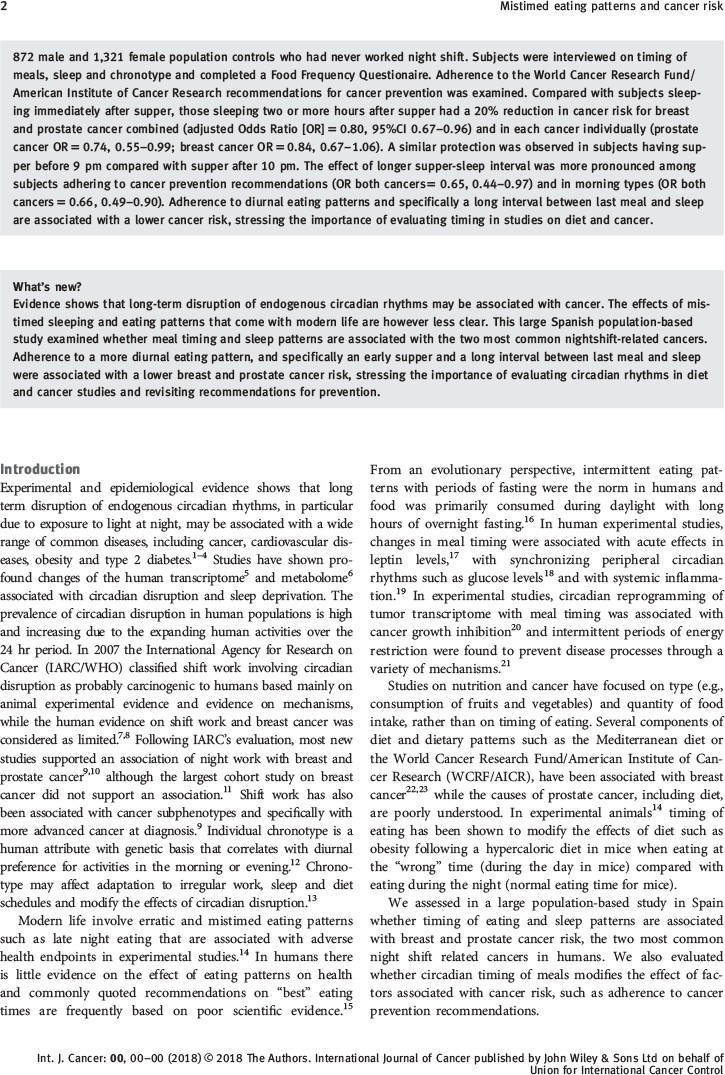
Evidence shows that long-term disruption of endogenous circadian rhythms may be associated with cancer. The effects of mistimed sleeping and eating patterns that come with modern life are however less clear. This large Spanish population-based study examined whether meal timing and sleep patterns are associated with the two most common nightshift-related cancers. Adherence to a more diurnal eating pattern, and specifically an early supper and a long interval between last meal and sleep were associated with a lower breast and prostate cancer risk, stressing the importance of evaluating circadian rhythms in diet and cancer studies and revisiting recommendations for prevention.
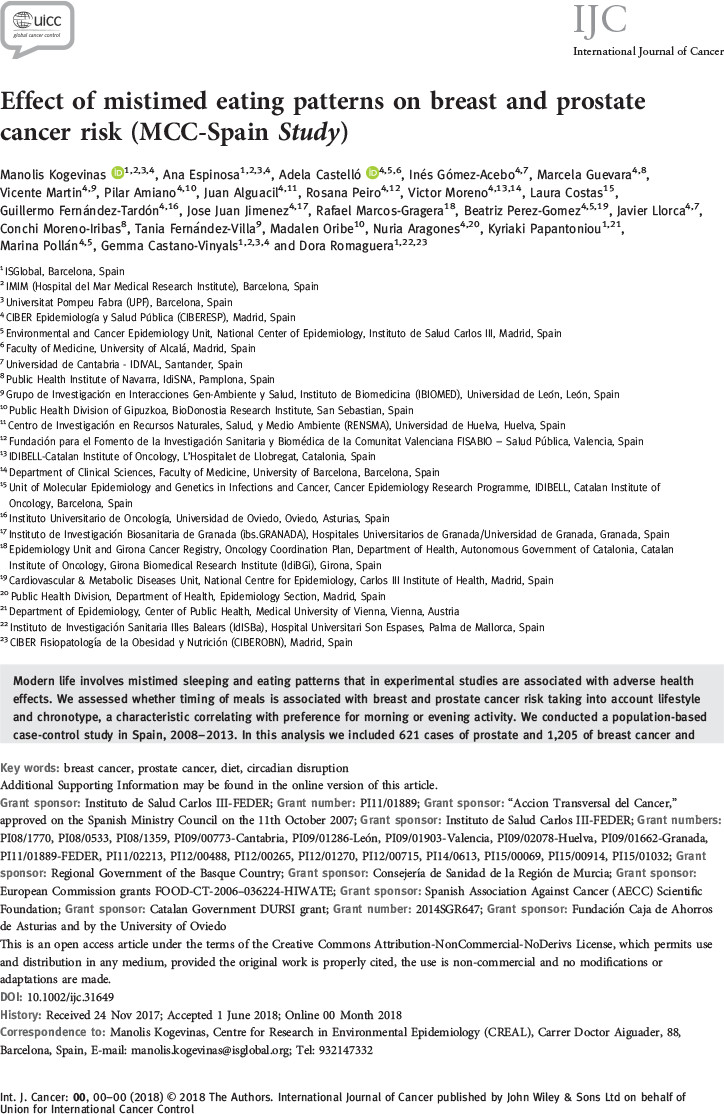
Modern life involves mistimed sleeping and eating patterns that in experimental studies are associated with adverse health effects. We assessed whether timing of meals is associated with breast and prostate cancer risk taking into account lifestyle and chronotype, a characteristic correlating with preference for morning or evening activity. We conducted a population-based case-control study in Spain, 2008-2013. In this analysis we included 621 cases of prostate and 1,205 of breast cancer and 872 male and 1,321 female population controls who had never worked night shift. Subjects were interviewed on timing of meals, sleep and chronotype and completed a Food Frequency Questionaire. Adherence to the World Cancer Research Fund/American Institute of Cancer Research recommendations for cancer prevention was examined. Compared with subjects sleeping immediately after supper, those sleeping two or more hours after supper had a 20% reduction in cancer risk for breast and prostate cancer combined (adjusted Odds Ratio [OR]=0.80, 95%CI 0.67-0.96) and in each cancer individually (prostate cancer OR=0.74, 0.55-0.99; breast cancer OR=0.84, 0.67-1.06). A similar protection was observed in subjects having supper before 9 pm compared with supper after 10 pm. The effect of longer supper-sleep interval was more pronounced among subjects adhering to cancer prevention recommendations (OR both cancers= 0.65, 0.44-0.97) and in morning types (OR both cancers=0.66, 0.49-0.90). Adherence to diurnal eating patterns and specifically a long interval between last meal and sleep are associated with a lower cancer risk, stressing the importance of evaluating timing in studies on diet and cancer.
DOI: 10.1002/ijc.31649





 苏公网安备32059002004080号