










































理论上,化疗是杀死癌细胞的最佳选择。一定剂量化学毒性药物与肿瘤混合,可使肿瘤无法生存或传播。但是杀死肿瘤所需剂量对于患者同样致命。因此,在化疗过程中,医生必须使用较低剂量。这种做法有两个不利之处。首先,这样允许一些肿瘤细胞生存,变得耐药,并转移到其他器官;第二,这样对人体依然有害。一旦癌症发生转移,往往具有更强的浸润性和耐药性,往往难以治疗。因此,如何更好地发挥化疗有利之处,并降低其副作用,成为目前亟待解决的问题。
2017年7月5日,美国科学促进会《科学》旗下《转化医学》在线发表阿尔伯特爱因斯坦医学院、蒙特菲奥里医学中心、康奈尔大学威尔医学院的研究报告,发现新辅助化疗可能通过肿瘤转移微环境(TMEM)机制诱发乳腺癌转移。
乳腺癌细胞通过TIE2/MENACalc/MENAINV通路进行扩散即为肿瘤转移微环境(TMEM),根据临床验证为乳腺癌患者转移的预后标志。该研究发现,术前新辅助化疗可使肿瘤缩小,同时也可能为肿瘤细胞进入血液循环提供途径,使其容易发生远处转移。在接受多柔比星+环磷酰胺+紫杉醇新辅助化疗的小鼠中,反映乳腺癌细胞转移“门窗”的TMEM评分、MENAINV表达密度和活性显著增加。同时还发现,在接受乳腺癌化疗的小鼠中,全身和肺部的乳腺癌细胞数量显著增加。
该研究的目的并非阻止患者接受新辅助化疗,而是建议创造一种更好地监测接受化疗患者肿瘤细胞移动的方法。目前,其中一种方法是在首次术前新辅助化疗后获取少量肿瘤组织,如果观察到标志物评分增加,建议先停止化疗并进行手术,然后再进行术后辅助化疗。此外,通过施用TIE2抑制剂瑞巴替尼或敲除MENA基因,可以逆转化疗诱导的TMEM活性增加和乳腺癌细胞转移。
Sci Transl Med. 2017 Jul 5;9(397):eaan0026.
Neoadjuvant chemotherapy induces breast cancer metastasis through a TMEM-mediated mechanism.
Karagiannis GS, Pastoriza JM, Wang Y, Harney AS, Entenberg D, Pignatelli J, Sharma VP, Xue EA, Cheng E, D'Alfonso TM, Jones JG, Anampa J, Rohan TE, Sparano JA, Condeelis JS, Oktay MH.
Albert Einstein College of Medicine, Bronx, NY, USA; Weill Cornell Medicine, New York, NY, USA; Montefiore Medical Center, Bronx, NY, USA.
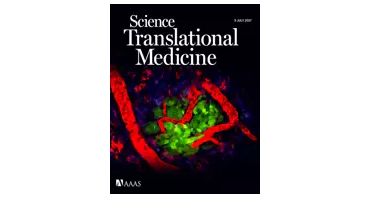
Closing the door to cancer cells: Breast cancer is one of the most common tumor types, and metastasis greatly increases the risk of death from this disease. By studying the process of intravasation or entry of cells into the vasculature, Karagiannis et al. discovered that, in addition to killing tumor cells, chemotherapy treatment can also increase intravasation. Groups of cells collectively known as tumor microenvironment of metastasis (TMEM) can serve as gateways for tumor cells entering the vasculature, and the authors discovered that several types of chemotherapy can increase the amounts of TMEM complexes and circulating tumor cells in the bloodstream. The researchers also determined that a drug called rebastinib can interfere with TMEM activity and help overcome the increased risk of cancer cell dissemination.
Breast cancer cells disseminate through TIE2/MENACalc/MENAINV-dependent cancer cell intravasation sites, called tumor microenvironment of metastasis (TMEM), which are clinically validated as prognostic markers of metastasis in breast cancer patients. Using fixed tissue and intravital imaging of a PyMT murine model and patient-derived xenografts, we show that chemotherapy increases the density and activity of TMEM sites and Mena expression and promotes distant metastasis. Moreover, in the residual breast cancers of patients treated with neoadjuvant paclitaxel after doxorubicin plus cyclophosphamide, TMEM score and its mechanistically connected MENAINV isoform expression pattern were both increased, suggesting that chemotherapy, despite decreasing tumor size, increases the risk of metastatic dissemination. Chemotherapy-induced TMEM activity and cancer cell dissemination were reversed by either administration of the TIE2 inhibitor rebastinib or knockdown of the MENA gene. Our results indicate that TMEM score increases and MENA isoform expression pattern changes with chemotherapy and can be used in predicting prometastatic changes in response to chemotherapy. Furthermore, inhibitors of TMEM function may improve clinical benefits of chemotherapy in the neoadjuvant setting or in metastatic disease.
PMID: 28679654
PII: eaan0026
DOI: 10.1126/scitranslmed.aan0026





 苏公网安备32059002004080号